


THE PISA EOE ADAPTATION QUESTIONNAIRE FOR ADAPTIVE BEHAVIORS ACCURATELY MONITORS HISTOLOGICAL DISEASE ACTIVITY TRENDS FOLLOWING TREATMENT IN PATIENTS WITH EOSINOPHILIC ESOPHAGITIS : A PROSPECTIVE, LONGITUDINAL STUDY
Authors: Irene Solinas1, Mauro Mitilini1, Gaia Cairoli1, Federico Testi1, Isabella Dulmin, Giulio Del Corso, Massimo Bellini1, Edoardo V. Savarino2, Nicola de Bortoli1, Pierfrancesco Visaggi1 Affiliations:
- Gastroenterology Unit, Department of Translational Research and New Technologies in Medicine and Surgery, University of Pisa, Pisa, Italy
- Institute of Information Science and Technologies “A. Faedo”, National Research Council of Italy (CNR), Pisa, Italy
- Endoscopy Unit, Azienda Ospedaliero Universitaria Pisana, Pisa, Italy
- Division of Gastroenterology, Department of Surgery, Oncology and Gastroenterology, University of Padua, Padua, Italy
Background and aims:
The Pisa EoE Adaptation Questionnaire (PiEAQ) on adaptive behaviors at mealtime significantly improves the correlation between dysphagia scores and histological disease activity (HDA) in eosinophilic esophagitis (EoE). Whether longitudinal variations of PiEAQ scores (∆PiEAQ) can capture HDA trends following pharmacological treatment of EoE has not been investigated.
Methods:
Consecutive adults (>18 years) with histologically active EoE (i.e., ≥15 eos/high-power field) were prospectively enrolled. Clinical characteristics, HDA, a recall-modified dysphagia symptom questionnaire (mDSQ), esophageal hypervigilance and anxiety scale (EHAS), and PiEAQ (drinking water to push the bolus, lubricating food, chewing for long, and blending food) were recorded longitudinally at baseline (T0) and 12 weeks post-treatment using a 30-day recall period (T1). ROC curve analysis with DeLong test was used to calculate the diagnostic accuracy (AUC) of clinical scores for predicting HDA following treatment. Significance threshold was p<0.05.
Results:
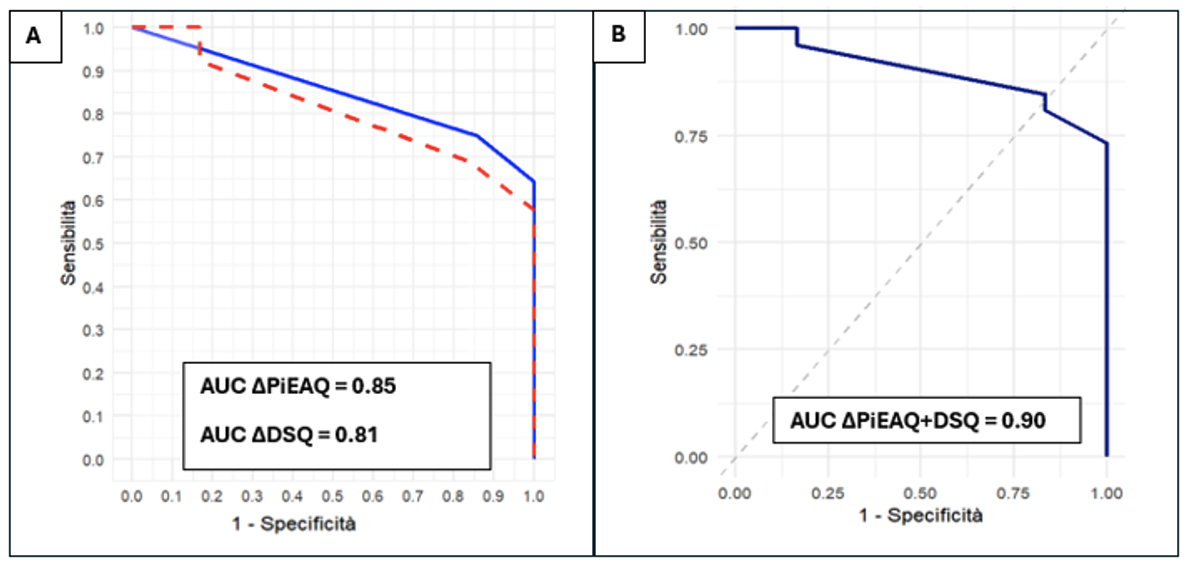
Thirty-seven histologically active EoE patients were included (Table 1). The mDSQ, PiEAQ, and EHAS score at baseline were 2.97 (IQR, 2-5), 2.00 (IQR, 1-3), and 21 (IQR, 14– 25), respectively. Following treatment with budesonide orodispersible tablets (72.2%), PPIs (19.6%), dupilumab (5.5%), or milk-free diet (2.7%), histological remission was achieved in 78.4% of patients, while 21.6% remained histologically active. Post-treatment (T1), mDSQ, PiEAQ, and EHAS scores decreased significantly only in patients who achieved histological remission (Table 2 and Figure1). ROC curve analysis showed that a post-treatment reduction of at least 2 adaptive behaviors compared to baseline (∆PiEAQ=-2) had AUC of 85.0%, with 100% specificity and 64% sensitivity for the identification of patients achieving histological remission following treatment. Similarly, a post-treatment reduction of at least 3 points in mDSQ scores compared to baseline (∆mDSQ=-3) had AUC of 81.1% with 100% specificity and 57.7% sensitivity. The non-inferiority analysis showed that the ∆PiEAQ had similar performance to ∆DSQ (DeLong p-value= 0.46). A combined score integrating both ∆PiEAQ and ∆DSQ scores increased the AUC of clinical scores for capturing variations of HDA post-treatment to 90%, with 100% specificity and 73.1% sensitivity for detecting patients achieving histological remission post-treatment (Figure 2).
Conclusions:
The PiEAQ is the first questionnaire investigating adaptive behaviors as a standalone domain in EoE. We demonstrated that longitudinal variations in PiEAQ scores are sensitive to HDA variations over time and can monitor histological disease activity trends after treatment. This study confirms that, similar to dysphagia, adaptive behaviors contribute to disease burden in EoE and improve with treatment. Table 1. Baseline Characteristics  Table 2. Variations of PiEAQ and DSQ scores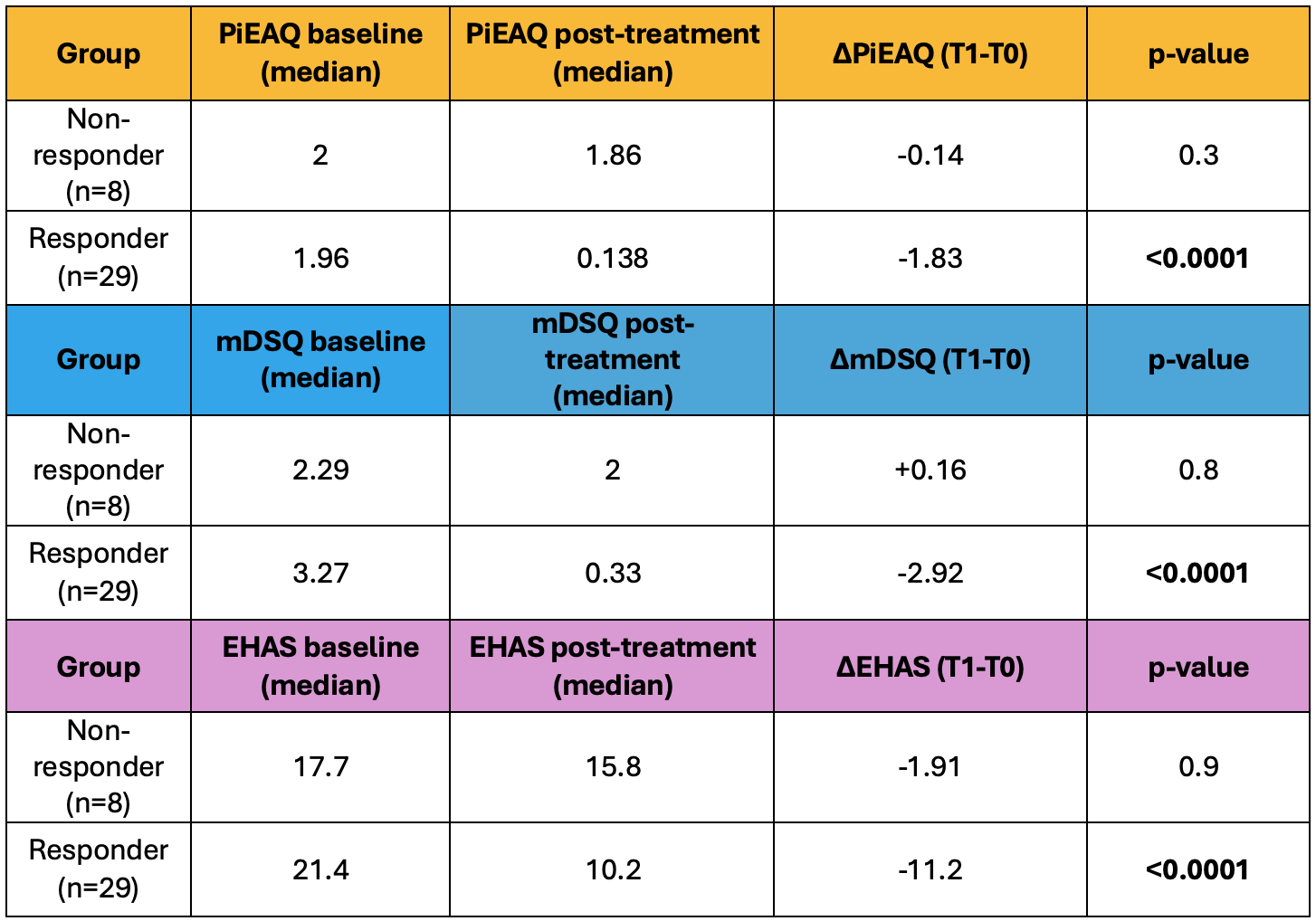
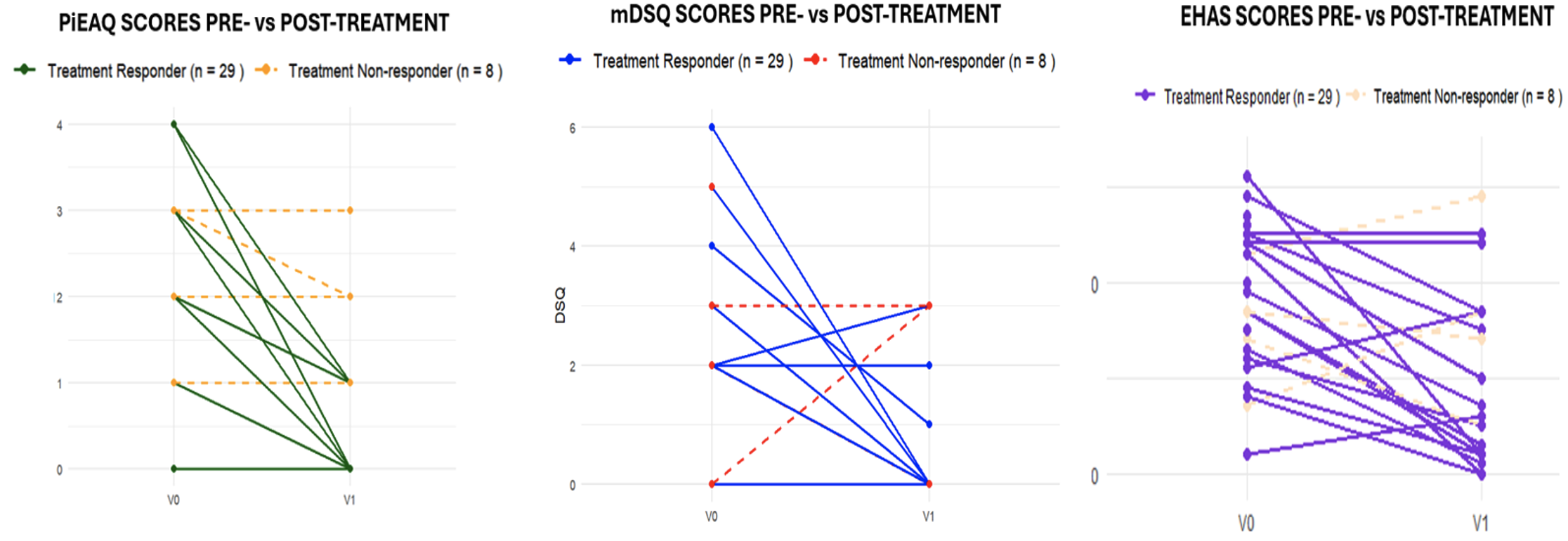
Figure 2. PiEAQ and DSQ scores at baseline and post-treatment (by patient), and ROC curves.
VALUTA ABSTRACT
Vota ogni categoria
| Originality | |
| Clarity | |
| Rationale | |
| Objectives | |
| Endpoint measures | |
| Statistics | |
| Results | |
| Relevance | |
|
Media
|
|

|
|
situs gacor
situs togel
slot resmi
slot gacor hari ini
monperatoto
monperatoto
togel online
situs toto
toto slot
toto togel
situs gacor
monperatoto
toto togel
toto togel
Efficacy Of Budesonide Orodispersible Tablet Split Versus Single Dose For Maintenance Of Remission In Eosinophilic Esophagitis: Total Daily Dose May Matter More Than the Administration Frequency
Authors: Pierfrancesco Visaggi, Gaia Cairoli, Alberto Barchi, Edoardo Vespa, Mauro Mitilini, Federico Testi, Lorenzo Bini, Isabella Dulmin, Edoardo Vincenzo Savarino and Nicola de Bortoli
Background and aims:
Budesonide orodispersible tablet (BOT) is the only approved topical steroid available in Europe for the induction and maintenance of remission in patients with eosinophilic esophagitis (EoE). Available randomized controlled trials have demonstrated that, following induction of histological remission with BOT 1mg twice daily (bid), patients can be maintained in remission with BOT 0.5mg bid. It is currently unknown whether a dose of 1mg once daily (od) has comparable efficacy to 0.5mg bid.
Methods:
In this prospective study conducted at two tertiary referral centers for EoE, we enrolled consecutive patients with EoE undergoing clinical, endoscopic, and histologic re-assessment while on maintenance treatment for EoE with BOT 0.5mg bid or BOT 1mg od. All included patients had achieved histological remission (i.e., <15 eosinophils/high-power field, eos/HPF) following induction of remission with BOT 1mg bid. At the end of the induction of remission period (T0), all patients were assessed using the dysphagia symptom questionnaire (DSQ), the EoE endoscopic reference score (EREFS), and peak eosinophil counts (PEC). At re-assessment while on maintenance treatment (T1), all patients underwent 1) assessment of dysphagia and adaptive behaviors with the DSQ and the Pisa EoE Adaptation Questionnaire v1.0 (PiEAQ). Clinical remission was defined as DSQ not increasing >30% compared to T0. 2) upper endoscopy (EGDS) with assessment of EREFS score and at least six esophageal biopsies, and 3) histological assessment using the EoE Histology Scoring System (EoEHSS). In addition, a comprehensive global assessment of clinical, endoscopic, and histologic findings was performed using the validated index of severity for EoE (I-SEE score). Kruskal-Wallis Rank Sum Test and Pearson’s Chi-squared were used for comparisons. Significance threshold was p<0.05.
Results:
Fifty-six patients were included (46 males and 10 females). Following histological remission with BOT 1mg bid, 28 (50%) initiated maintenance treatment with BOT 1mg od and 28 (50%) with BOT 0.5 bid. At the end of induction of remission (T0), the two groups had achieved similar outcomes, with comparable median DSQ [0 (0-28) vs 0 (0-28)], EREFS [1 (0-2) vs 1 (0-1)], and PEC [1 (0-7) vs 1.5 (0-4)] (all p>0.3) (Table 1). At the end of the maintenance treatment (T1), the two groups had been taking maintenance treatment for a comparable duration [20 weeks (12 – 36) vs 20 weeks (12 – 32; p=0.7). Persistent histological and clinical remission at T1 was present in 86% of BOT 1mg od versus 93% of BOT 0.5 bid (p=0.7). In addition, EREFS scores were comparable between groups at T1 [1 (0-2) vs 1 (0-2), p=0.8]. Similarly, the EoEHSS stage and grade was comparable between groups, as was the PiEAQ score [1.5 (0.75-2) vs 0.5 (0-2); p=0.06], and the I-SEE score [ 3 (2-4) vs 3 (2-4); p=0.5] (Table 2).
Conclusions:
Persistent clinical endoscopic, and histological remission was maintained in most patients treated either with BOT 1mg od or BOT 0.5mg bid for a median of 20 weeks, indicating that the total daily dose of BOT 1mg may be more important that the frequency of administration, at least in the short term. Table 1. Patients’ data at the end of the induction of remission period 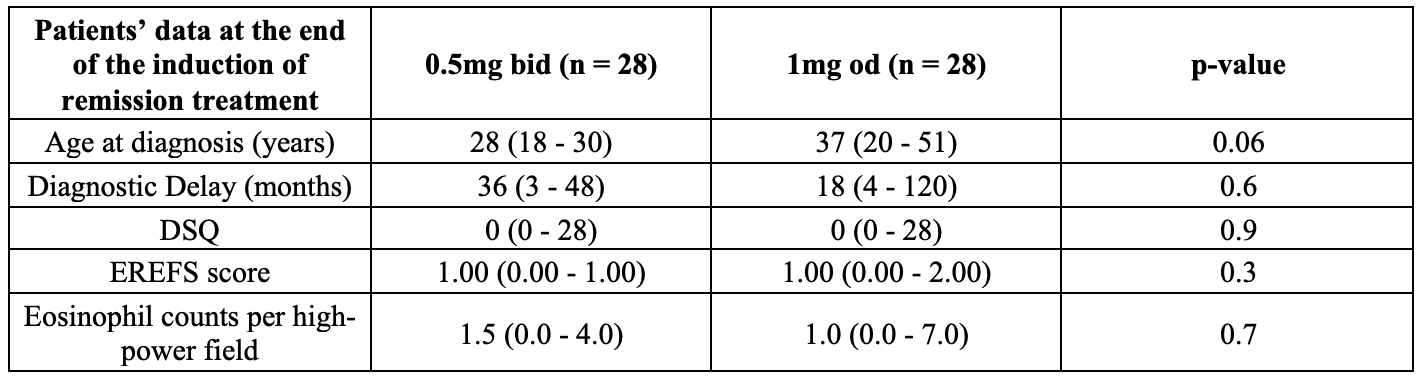 Table 2. Patients’ data at the end of the maintenance period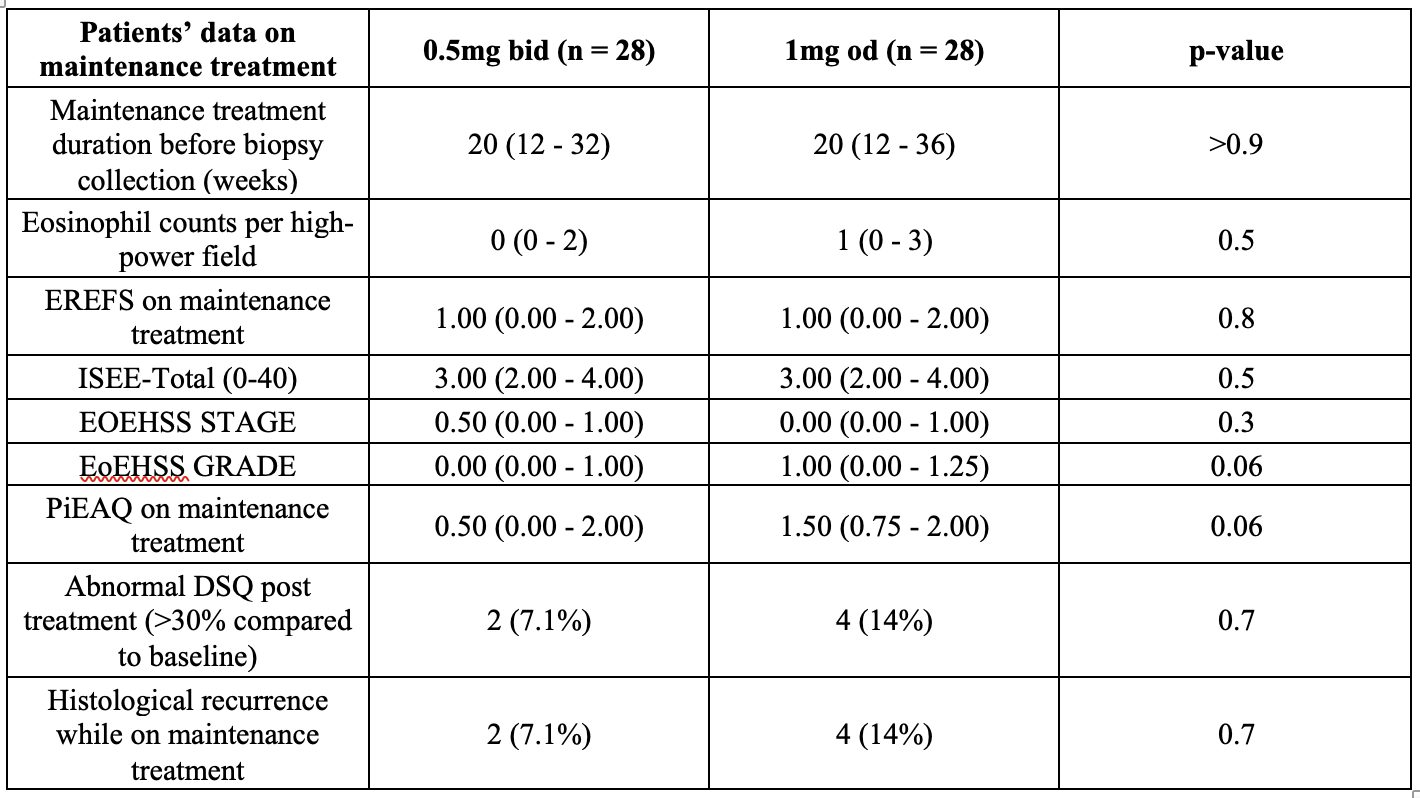
VALUTA ABSTRACT
Vota ogni categoria
| Originality | |
| Clarity | |
| Rationale | |
| Objectives | |
| Endpoint measures | |
| Statistics | |
| Results | |
| Relevance | |
|
Media
|
|
|
|
|
situs gacor
situs togel
slot resmi
slot gacor hari ini
monperatoto
monperatoto
togel online
situs toto
toto slot
toto togel
situs gacor
monperatoto
toto togel
toto togel
INCIDENTAL DIAGNOSIS OF AUTOIMMUNE HEPATITIS IN YOUNG MAN WITH CELIAC DISEASE
Authors: Ferdy Junior Gatti, Carlo Soldaini, Giulia Verrusio, Benedetta Falcone, Emanuele Siani, Max Speranza, Natasha Sica, Carolina Gizzi, Antonella Santonicola, Università degli studi di Salerno.
Background and aims:
The diagnosis of autoimmune hepatitis is often very complicated. Missed diagnoses still represent a portion of the pathology, especially in the initial phase. Failure to make an initial diagnosis can have serious consequences in the patient’s prognosis, leading to cirrhosis or death due to liver failure. We are talking about a pathology with an incidence of 1 in 100,000 per year, with a greater prevalence in females. No sign or symptoms, negative serology and often serum transaminase confuse the diagnosis. We present a single case of a small elevation of transaminases which led to a diagnosis of asymptomatic celiac disease, but which was a sign of something else.
Methods:
24-year-old man with an episode of nausea, anorexia and loss of 4-5 kg in a week, which resolved spontaneously without drugs. During the episode had hyperchromic urine, yellowing of skin and eyes. After 1 month small increase of serum transaminases x 1.5. Regular bowel function. No clinical signs. US regular. Anti-HbsAg and HCV-Ab negative. After another month he had highly increase of serum transaminases with AST x 27 and ALT x50 GGT x3, Total bilirubin 2.85. Negative ANA, AMA, LKM, IgA anti TTG, anti EBV, anti CMV, alpha1 anti trypsian slight increase. He performed a new serum analysis with increase of anti-TTG IgA. He subsequently performed genetics for celiac disease and confirmed homozygous DQ2. Performs EGDS for suspected celiac disease which documents nodularity in bulb and DII scalloping. Histological examination shows Marsh 3B. After 150 g gluten daily intake had IgA anti TTG x 4. A diagnosis of celiac disease is made and he started GFD with serum transaminases x 2 After 2 months with good adherence to GFD has AST x20 and ALT x 50. He denies alcohol abuse. Negative hemochromatosis mutations. Stable weight, Regular bowel function. We perform liver biopsy. The histological examination documents Histological Activity index acc. Knodell modified by Ishak: 7 Grading.
Results:
Diagnosis is moderately active chronic autoimmune hepatitis. Therapy is started with prednisone 40 mg daily. With AST x10 and ALT x 20 After 15 days of therapy AST x 5 and ALT x9, therefore values halving and normal bilirubin. Currently under follow-up in our Hospital
Conclusions:
Although the history is still unknown and the histological exam is compatible but not certain, the good response to steroid therapy is a positive factor that proves the correctness of the diagnosis. This diagnostic difficulty leads us to always evaluate the autoimmune cause in a young patient without risk factors with a small increase in transaminases.
VALUTA ABSTRACT
Vota ogni categoria
| Originality | |
| Clarity | |
| Rationale | |
| Objectives | |
| Endpoint measures | |
| Statistics | |
| Results | |
| Relevance | |
|
Media
|
|
|
|
|
situs gacor
situs togel
slot resmi
slot gacor hari ini
monperatoto
monperatoto
togel online
situs toto
toto slot
toto togel
situs gacor
monperatoto
toto togel
toto togel
