


THE PISA EOE ADAPTATION QUESTIONNAIRE FOR ADAPTIVE BEHAVIORS ACCURATELY MONITORS HISTOLOGICAL DISEASE ACTIVITY TRENDS FOLLOWING TREATMENT IN PATIENTS WITH EOSINOPHILIC ESOPHAGITIS : A PROSPECTIVE, LONGITUDINAL STUDY
AREA TEMATICA: General gastro
THE PISA EOE ADAPTATION QUESTIONNAIRE FOR ADAPTIVE BEHAVIORS ACCURATELY MONITORS HISTOLOGICAL DISEASE ACTIVITY TRENDS FOLLOWING TREATMENT IN PATIENTS WITH EOSINOPHILIC ESOPHAGITIS : A PROSPECTIVE, LONGITUDINAL STUDY
Authors: Irene Solinas1, Mauro Mitilini1, Gaia Cairoli1, Federico Testi1, Isabella Dulmin, Giulio Del Corso, Massimo Bellini1, Edoardo V. Savarino2, Nicola de Bortoli1, Pierfrancesco Visaggi1 Affiliations:
- Gastroenterology Unit, Department of Translational Research and New Technologies in Medicine and Surgery, University of Pisa, Pisa, Italy
- Institute of Information Science and Technologies “A. Faedo”, National Research Council of Italy (CNR), Pisa, Italy
- Endoscopy Unit, Azienda Ospedaliero Universitaria Pisana, Pisa, Italy
- Division of Gastroenterology, Department of Surgery, Oncology and Gastroenterology, University of Padua, Padua, Italy
Background and aims:
The Pisa EoE Adaptation Questionnaire (PiEAQ) on adaptive behaviors at mealtime significantly improves the correlation between dysphagia scores and histological disease activity (HDA) in eosinophilic esophagitis (EoE). Whether longitudinal variations of PiEAQ scores (∆PiEAQ) can capture HDA trends following pharmacological treatment of EoE has not been investigated.
Methods:
Consecutive adults (>18 years) with histologically active EoE (i.e., ≥15 eos/high-power field) were prospectively enrolled. Clinical characteristics, HDA, a recall-modified dysphagia symptom questionnaire (mDSQ), esophageal hypervigilance and anxiety scale (EHAS), and PiEAQ (drinking water to push the bolus, lubricating food, chewing for long, and blending food) were recorded longitudinally at baseline (T0) and 12 weeks post-treatment using a 30-day recall period (T1). ROC curve analysis with DeLong test was used to calculate the diagnostic accuracy (AUC) of clinical scores for predicting HDA following treatment. Significance threshold was p<0.05.
Results:
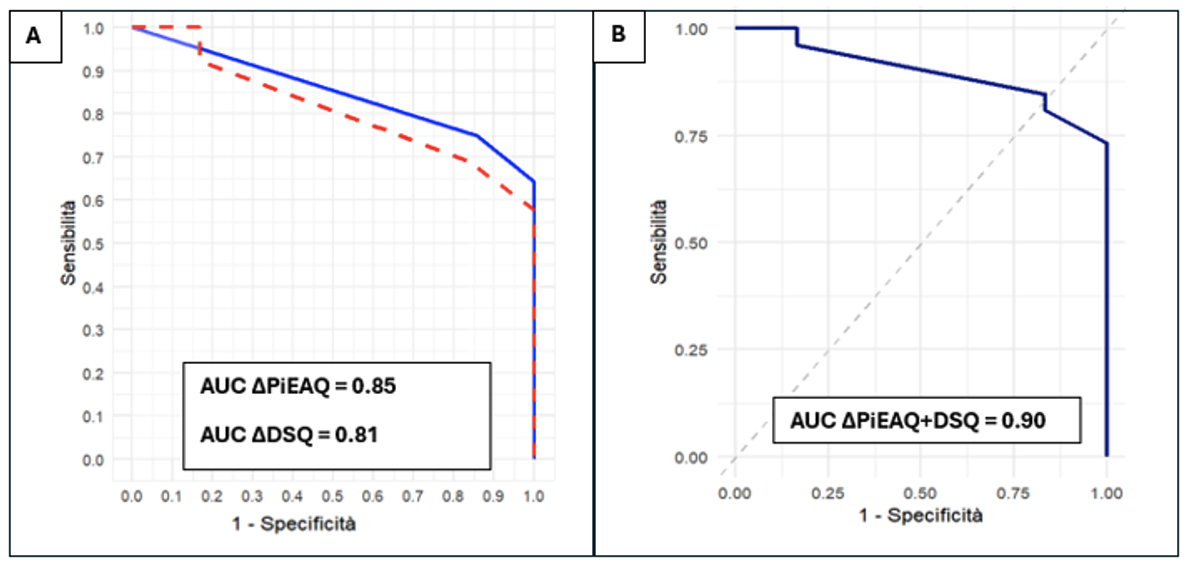
Thirty-seven histologically active EoE patients were included (Table 1). The mDSQ, PiEAQ, and EHAS score at baseline were 2.97 (IQR, 2-5), 2.00 (IQR, 1-3), and 21 (IQR, 14– 25), respectively. Following treatment with budesonide orodispersible tablets (72.2%), PPIs (19.6%), dupilumab (5.5%), or milk-free diet (2.7%), histological remission was achieved in 78.4% of patients, while 21.6% remained histologically active. Post-treatment (T1), mDSQ, PiEAQ, and EHAS scores decreased significantly only in patients who achieved histological remission (Table 2 and Figure1). ROC curve analysis showed that a post-treatment reduction of at least 2 adaptive behaviors compared to baseline (∆PiEAQ=-2) had AUC of 85.0%, with 100% specificity and 64% sensitivity for the identification of patients achieving histological remission following treatment. Similarly, a post-treatment reduction of at least 3 points in mDSQ scores compared to baseline (∆mDSQ=-3) had AUC of 81.1% with 100% specificity and 57.7% sensitivity. The non-inferiority analysis showed that the ∆PiEAQ had similar performance to ∆DSQ (DeLong p-value= 0.46). A combined score integrating both ∆PiEAQ and ∆DSQ scores increased the AUC of clinical scores for capturing variations of HDA post-treatment to 90%, with 100% specificity and 73.1% sensitivity for detecting patients achieving histological remission post-treatment (Figure 2).
Conclusions:
The PiEAQ is the first questionnaire investigating adaptive behaviors as a standalone domain in EoE. We demonstrated that longitudinal variations in PiEAQ scores are sensitive to HDA variations over time and can monitor histological disease activity trends after treatment. This study confirms that, similar to dysphagia, adaptive behaviors contribute to disease burden in EoE and improve with treatment. Table 1. Baseline Characteristics  Table 2. Variations of PiEAQ and DSQ scores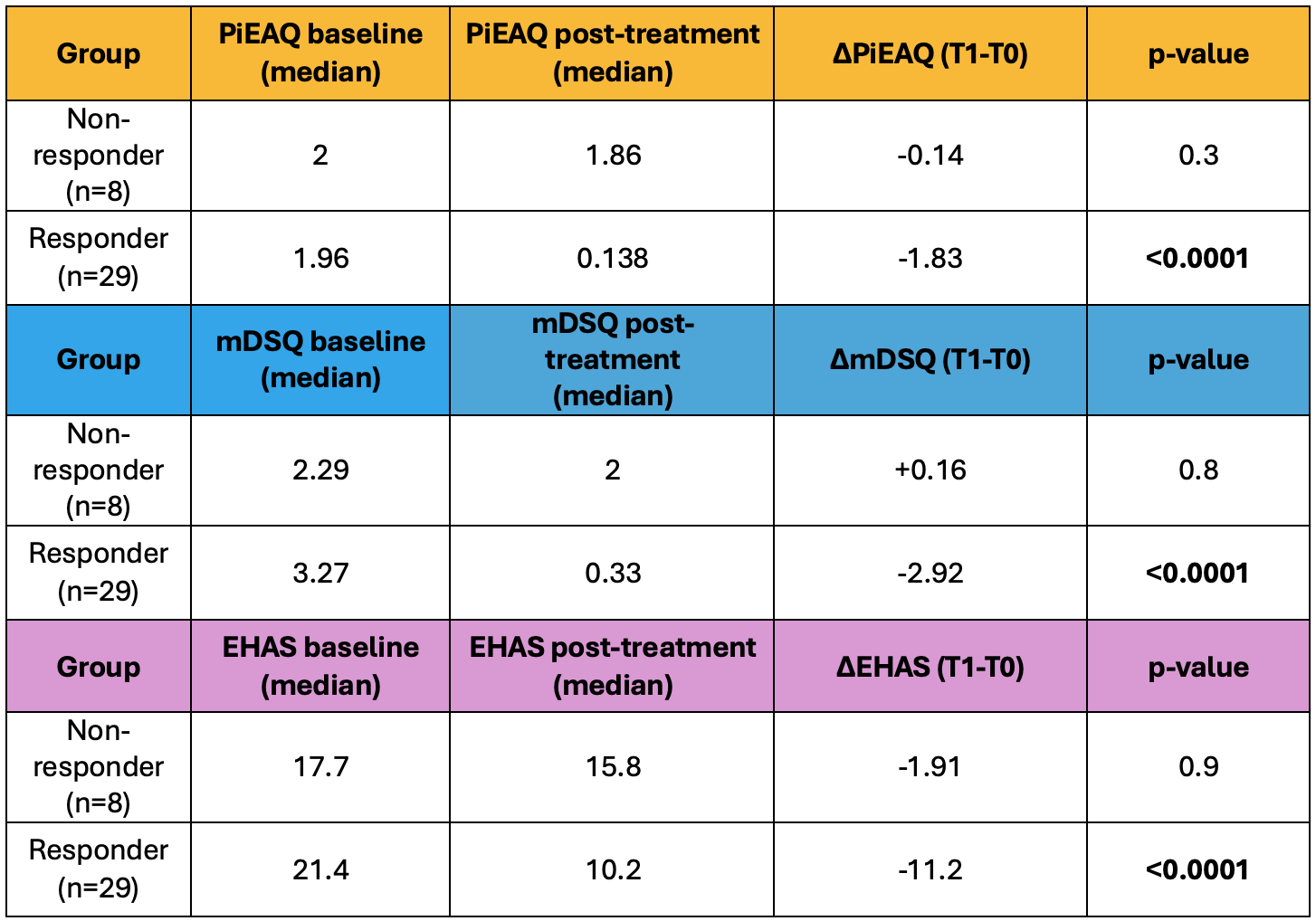
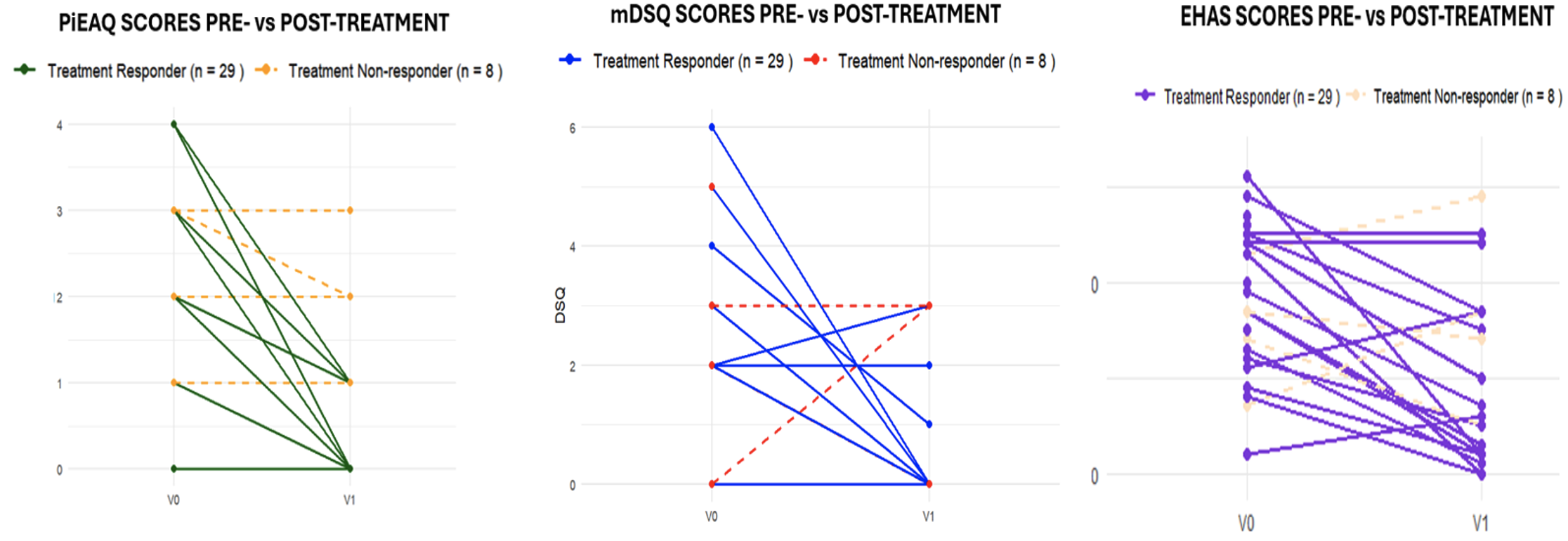
Figure 2. PiEAQ and DSQ scores at baseline and post-treatment (by patient), and ROC curves.
VALUTA ABSTRACT
Vota ogni categoria
| Originality | |
| Clarity | |
| Rationale | |
| Objectives | |
| Endpoint measures | |
| Statistics | |
| Results | |
| Relevance | |
|
Media
|
|

|
|
situs gacor
situs togel
slot resmi
slot gacor hari ini
monperatoto
monperatoto
togel online
situs toto
toto slot
toto togel
situs gacor
monperatoto
toto togel
toto togel

 Reappraisal of the Eosinophilic Esophagitis Endoscopic Reference Score (EREFS):...
Lascia un Commento
Vuoi partecipare alla discussione?Sentitevi liberi di contribuire!