

AREA TEMATICA: General Gastro
Background and aims:
The Milan Score, developed in 2024, is a composite high-resolution manometry (HRM) tool for predicting GERD probability. It incorporates four pathophysiological domains: esophageal body motility (ineffective esophageal motility, IEM), EGJ pressure (EGJ-contractile integral, EGJ-CI), response to increased intra-abdominal pressure (straight leg raise, SLR), and EGJ morphology. Despite its validation in diverse settings, IEM and EGJ-CI lacked significance in the original model, the SLR exerted disproportionate influence on the score, and demographic variables were not accounted for. This study aimed to refine the Milan Score components and to integrate demographic characteristics.
Methods:
We performed a retrospective multi-institutional international cohort study from 40 tertiary and peripheral centers across three continents (25 Europe, 12 North/Latin America, 3 Asia).
Patients aged 18–75 years with complete HRM, pH-impedance or wireless 48–96h monitoring were included. Exclusion criteria included prior foregut surgery, large axial or para-esophageal hiatal hernia and major motility disorders. GERD was defined per Lyon Consensus 2.0. The population was randomly divided in a development and validation cohort (70-30%). A multivariable logistic model performed in the development cohort selected the strongest independent predictor for each pathophysiological domain alongside demographic variables. The final score was validated in the validation cohort.
Results:
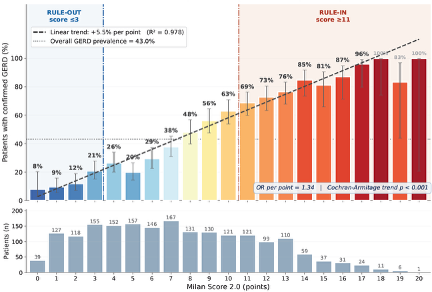
A total of 2113 patients were included (median age 51 years, BMI 25.9 kg/m², 59% female). Definitive GERD was present in 43.4%. Patients with GERD were more frequently male (55.7% vs. 32.2%, p<0.001), older (54 vs. 52 years, p<0.001) and had higher BMI (27.3 vs. 24.9, p<0.001). Number of failed swallows, LES basal pressure, SLR response and EGJ morphology were the strongest manometric predictors and were included alongside age, sex and BMI. The strongest independent predictors were SLR response (OR 4.377), EGJ type 3 (OR 3.700), and male sex (OR 2.385). The score was simplified by assigning integer point values to each variable, according to the odds ratio of the original model with a final range from 0 (lowest GERD risk) to 20 (highest GERD risk) (Table 1). The novel score showed a strong linear trend, with GERD probability increasing by 5.5 percentage points per additional point of the score (R² = 0.978) (Figure 1). ROC analysis showed an area under the curve of 0.808. In the development cohort, the negative predictive value at the rule-out threshold (≤3 points) was 91.6% and the positive predictive value at the rule-in threshold (≥11 points) was 79.0%. The score showed good calibration (calibration slope 0.851, Hosmer-Lemeshow test p=0.228).
Conclusions:
The novel Milan Score integrates recalibrated manometric and demographic predictors into a refined and simplified GERD risk stratification tool. Its development across 40 centers on three continents substantially enhances generalizability.
Table 1. a. Multivariable model showing the variables selected for the novel Milan Score. b. The novel Milan Score with ordinal numbers for a simplified calculation
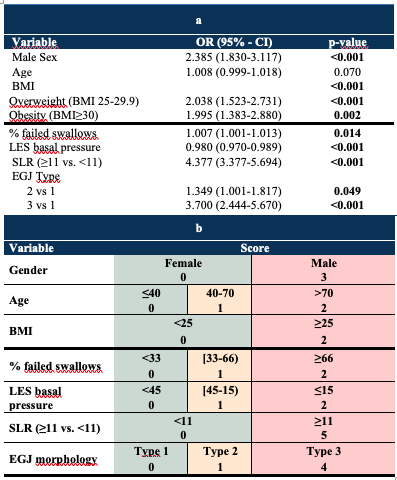
Figure 1. GERD probability according to the Milan Score integer points
VALUTA ABSTRACT
Vota ogni categoria
| Originality | |
| Clarity | |
| Rationale | |
| Objectives | |
| Endpoint measures | |
| Statistics | |
| Results | |
| Relevance | |
|
Media
|
|

|
|

