

AREA TEMATICA: Endoscopy
Background and aims:
Colorectal endoscopic mucosal resection (EMR) often requires coordinated teamwork for snare manipulation. To improve autonomy and precision, the Single-Operator Finger-Assisted technique (FAST-EMR) was developed using the Holdfinger device, allowing direct control of snare positioning and closure. Data on feasibility,efficacy and safety on this technique are lacking. We report a preliminary case-series assessing FAST-EMR for 15–25 mm non-pedunculated colorectal lesions.
Methods:
This retrospective case-series included consecutive patients treated with FAST-EMR for non-pedunculated colorectal lesions in 4 centers between December 2025 and May 2026.
We collected details of lesion characteristics, procedural data, histologic outcomes and clinical consequences for the patient.
Results:
43 colorectal lesions were included in the analysis. The mean lesion size was 19.5 mm. The most frequent lesion location was the sigmoid colon (32.6%).
All the FAST-EMR were completed without assistant support. En bloc and R0 resection rates were 93% and 88.4% respectively. Only two adverse events (4.7%) occurred: one post-polypectomy electrocoagulation syndrome and one post-procedural bleeding, managed respectively with medical therapy and successful endoscopic intervention.
Conclusions:
FAST-EMR appears to be a safe, feasible and promising technique for selected 15–25 mm non-pedunculated colorectal lesions. Future prospective studies are warranted to validate these results.
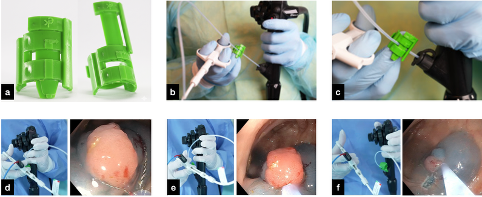
Fig.1 Holdfinger device and FAST-EMR technique: Holdfinger device (a), snare set-up (b) and insertion (c). FAST-EMR: snare landing over resection area (d), lesion capturing (e) and cutting (f)
VALUTA ABSTRACT
Vota ogni categoria
| Originality | |
| Clarity | |
| Rationale | |
| Objectives | |
| Endpoint measures | |
| Statistics | |
| Results | |
| Relevance | |
|
Media
|
|

|
|

