

AREA TEMATICA: General Gastro
Background and aims:
The Index of severity of EoE (I-SEE) is a validated index for the stratification of disease severity of eosinophilic esophagitis (EoE) based on symptoms, endoscopy, and histologic findings, but its complexity may limit routine clinical applicability. The Pisa Score, a multi-center validated patient-reported outcome measure assessing adaptive eating behaviors (AEBs) in EoE, demonstrated high accuracy for the diagnosis of EoE.
We investigated the ability of the Pisa score to stratify disease severity according to the I-SEE score and predict histologic response to treatment
Methods:
Consecutive histologically active (eos≥15/HPF) or inactive (eos <15/HPF) EoE patients were prospectively enrolled from three EoE tertiary referral centers. Demographics, clinical, endoscopic, histologic, and treatment data were recorded. AEBs were assessed using the Pisa Score (drinking water to facilitate bolus transit, avoidance of hard-texture foods, and positional changes during meals). Disease severity was calculated using a standard 40-point I-SEE score. Associations were evaluated using ANOVA, linear regression, Spearman correlation, and logistic regression. Predictive performance for histologic treatment response was assessed using ROC analysis and DeLong comparison.
Results:
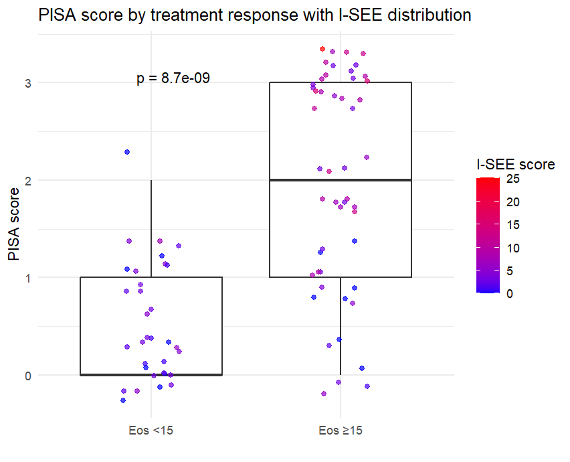
83 patients were included (39.7% inactive; 60.3% active), under treatment with budesonide (54.2%) or PPIs (45.8%). The Pisa Score showed a strong graded dose-response association with overall disease severity, increasing significantly across I-SEE strata (p<0.001). Linear regression confirmed a significant positive association between Pisa Score and I-SEE severity (β = 2.29, p<0.001). At the I-SEE domain level, the Pisa Score correlated with symptoms (ρ=0.43, p<0.001), endoscopic inflammatory features (ρ=0.35, p=0.001), and endoscopic fibrotic features (ρ=0.30, p=0.004). Stronger correlations were observed with histologic inflammatory activity (ρ=0.67, p<0.001, fig.1) and histologic fibrotic features (ρ=0.50, p<0.001). The Pisa Score accurately predicted treatment response (AUC 0.86, 95% CI 0.79–0.93), with 97% specificity of a cut-off ≥2. In logistic regression analysis, each one-point increase in Pisa Score was associated with a more than five-fold increase in the odds of active disease (OR 5.74, 95% CI 2.97–13.68, p<0.001). When directly compared, the Pisa Score showed significantly superior predictive performance compared with the I-SEE score (AUC 0.86 vs 0.75; DeLong test p=0.026), indicating improved discrimination for treatment response.
Conclusions:
The Pisa Score stratifies EoE severity with close alignment with the I-SEE score and strongly predicts treatment response, corroborating that AEBs substantially contribute to disease burden and are associated with therapeutic outcomes in EoE.
VALUTA ABSTRACT
Vota ogni categoria
| Originality | |
| Clarity | |
| Rationale | |
| Objectives | |
| Endpoint measures | |
| Statistics | |
| Results | |
| Relevance | |
|
Media
|
|

|
|

