

AREA TEMATICA: General Gastro
Background:
The Pisa EoE Adaptive Questionnaire (PiEAQ) was developed in a single-center setting as the first questionnaire investigating five different adaptive eating behaviors (AEBs) as a standalone domain in patients with eosinophilic esophagitis (EoE). While the score was highly predictive of histological disease activity and treatment response, a formal questionnaire building and validation process was not undertaken.
Aims and Methods:
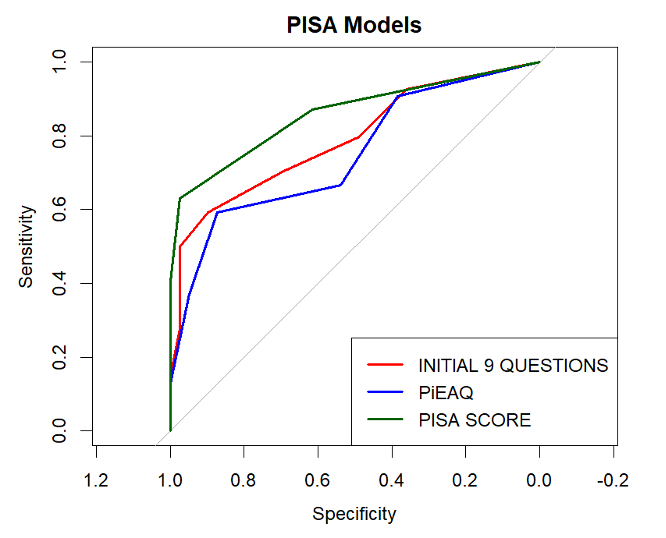
An expert panel expanded the PiEAQ instrument (5 items) to a 9-item version (Initial 9 Questions) based on literature review, content coverage, and clinical consensus. Comprehensibility was assessed according to a 5-point Likert scale. Consecutive patients with active or inactive EoE were prospectively enrolled across three tertiary referral centers. A multivariable logistic regression model including all 9 questionnaire items was first used to estimate variable importance based on absolute log-odds coefficients. Subsequently, LASSO regression was applied to minimize redundancy and collinearity among items. Three scoring systems were evaluated: PiEAQ, Initial 9 Questions, and a reduced PISA Score derived using LASSO-penalized logistic regression. Internal consistency of each score was assessed using Cronbach’s alpha. Discriminative validity was evaluated using receiver operating characteristic (ROC) analysis and area under the curve (AUC) compared against histologic disease activity. Optimal cut-off values for the PISA Score were determined using Youden’s index.
Results:
139 EoE patients were included (49.6% inactive). The initial 9 questions on AEBs showed excellent clarity (mean Likert score of 4.8/5), good internal consistency (alpha 0.853) and moderate discriminative ability for identifying histologically active EoE (AUC 0.790). The original PiEAQ (5 items) showed slightly lower performance (AUC 0.748; alpha 0.747). LASSO-penalized regression identified three key items as the most predictive of histologic activity: drinking water to facilitate bolus transit, avoidance of hard-texture/dry foods due to fear of food impaction, and positional changes during meals to facilitate bolus progression. The resulting PISA Score demonstrated the highest diagnostic accuracy for active EoE (AUC 0.858), with acceptable internal consistency (alpha 0.760). At the optimal cut-off (≥2 points), the PISA Score showed a sensitivity of 63% and a specificity of 97% for detecting active EoE.
Conclusions:
Validation metrics of the Pisa Score corroborate AEBs being a key domain and a strong predictor of histological disease activity of EoE. The multicenter setting and the consistency between LASSO selection and regression-based importance corroborate the generalizability of our findings.
VALUTA ABSTRACT
Vota ogni categoria
| Originality | |
| Clarity | |
| Rationale | |
| Objectives | |
| Endpoint measures | |
| Statistics | |
| Results | |
| Relevance | |
|
Media
|
|

|
|

